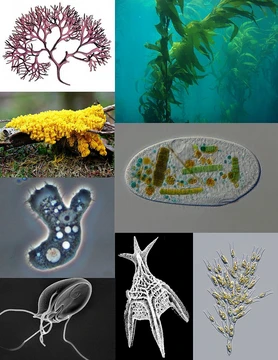
Algae And Protists 1-24
24 entries in the Algae And Protists compendium.
Brown algaeMulticellular marine algae forming kelp forests and floating mats.ChoanoflagellateClosest living relatives of animals, studied for multicellularity origins.ChromalveolataA proposed eukaryote supergroup later found not to be monophyletic.CiliateCiliates are protists with cilia and two distinct nuclei.CryptomonadAlgae and flagellates with ejectosomes and a nucleomorph.DiatomMicroalgae that produce much of Earth's oxygen and form silica shells.DinoflagellateSingle-celled protists causing red tides and bioluminescence.EuglenidSingle-celled flagellates with diverse nutrition and a flexible pellicle.EuglenozoaFlagellate Discoba including free-living species and human parasites.FlagellateOrganisms with whip-like flagella for motion and feeding.ForaminiferaSingle-celled protists with intricate shells, key to Earth's history.GlaucophyteUnicellular algae with ancestral plastids retaining a peptidoglycan layer.Golden algaeGolden algae are freshwater algae with siliceous cysts and two flagella.HaptophyteAlgae that produce minerals and include coccolithophores.KelpLarge brown algae forming dense underwater forests.LaminariaA genus of brown kelp with economic and medical significance.ParameciumUnicellular ciliates used as model organisms in biology.OomyceteFungus-like eukaryotic pathogens within the Stramenopiles.AnabaenaFilamentous cyanobacteria fixing nitrogen and producing neurotoxins.SpirogyraA genus of freshwater green algae with spiral chloroplasts.AmoebaUnicellular organisms that change shape using pseudopods.AmoebozoaA major group of amoeboid protists with lobose pseudopods.AlveolateA diverse protist clade with cortical alveoli and tubular mitochondrial cristae.ApicomplexaParasitic protozoans with apical complex for host cell invasion.
Browse Algae And Protists 1-24 in the interactive codex →