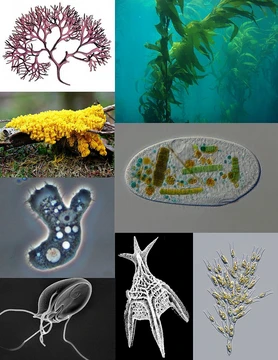
Brown algae
Multicellular marine algae forming kelp forests and floating mats.

Brown algae (sing.: alga) are a large group of photoautotrophic, multicellular organisms within the class Phaeophyceae. They belong to the Stramenopiles, one of the three major clades of the SAR supergroup, and are thus not closely related to red algae, green algae, or green plants. They include many seaweeds located in colder waters of the Northern Hemisphere and are the major seaweeds of temperate and polar regions. Many brown algae, such as members of the order Fucales, commonly grow along rocky seashores. Most brown algae live in marine environments, where they play an important role both as food and as a potential habitat. Their chloroplasts are surrounded by four membranes, suggesting secondary acquisition from a symbiotic relationship. Most contain the pigment fucoxanthin, which gives them their distinctive greenish-brown color. While brown algae are notable for their complex multicellularity and differentiated tissues, they are not unique among Stramenopiles in this regard—other members like some diatoms and xanthophytes also exhibit multicellular forms.
- field
- Marine biology, phycology
- known_for
- Largest and fastest-growing seaweeds; key habitat formers such as kelp forests and Sargassum mats; commercial and environmental significance through carbon fixation
- closest_relative
- Phylogenetic relationships are debated; Schizocladia isciensis and yellow-green algae are among the candidates, but no single closest relative is universally accepted.
Lore & Background
The rockweeds and leathery kelps are often the most conspicuous algae in their habitats. Regardless of size, all brown algae are multicellular; there are no known single-celled or colonial species. Their color ranges from olive green to various shades of brown, depending on the amount of fucoxanthin present and environmental factors like light, not specifically salinity. The body of all brown algae is termed a thallus, lacking the complex xylem and phloem of vascular plants. Structurally differentiated species typically possess a holdfast (a rootlike anchoring structure), a stipe (a stemlike structure that may be divided into pith, cortex, and epidermis), and flattened blades or laminae. Gas-filled floats called pneumatocysts provide buoyancy in many kelps and members of the Fucales, holding the lamina nearer the water surface for photosynthesis. Some species, such as Nereocystis luetkeana, bear a single large pneumatocyst between the stipe and blades, while Macrocystis pyrifera has a pneumatocyst at the base of each blade. Brown algae include the largest and fastest-growing seaweeds. Fronds of Macrocystis may grow as much as 50 cm per day under optimal conditions. They reproduce by means of flagellated spores and gametes that closely resemble cells of other Stramenopiles. Some species, such as Ascophyllum nodosum, have become subjects of extensive research due to their commercial importance. They also have environmental significance through carbon fixation.
Reader's Guide
Brown algae are of major ecological and commercial significance. As the dominant seaweeds of temperate and polar regions, they form critical marine habitats: Macrocystis creates underwater kelp forests that contain a high level of biodiversity, while Sargassum forms unique floating mats in the tropical Sargasso Sea that serve as habitats for many species. These algae play an important role both as food and as potential habitat for marine organisms. Some members, such as kelps, are used by humans as food. Their environmental significance extends to carbon fixation. Their evolutionary uniqueness lies in being Stramenopiles that developed multicellularity with differentiated tissues, while still reproducing via flagellated spores and gametes. Genetic studies show their closest relative to be Schizocladia isciensis, followed by yellow-green algae. The presence of fucoxanthin gives them their characteristic color, and their four-membrane chloroplasts indicate a secondary endosymbiotic origin.
Did You Know?
- Brown algae are the only major group of seaweeds that does not include single-celled or colonial forms.
- Brown algae range from olive green to brown depending on fucoxanthin concentration and light conditions, not salinity.
- Some brown algae have gas-filled floats called pneumatocysts that provide buoyancy and hold the blades near the water surface for photosynthesis.
Frequently Asked Questions
Who is Brown algae?
Brown algae are a large group of multicellular, photosynthetic marine organisms classified under the class Phaeophyceae. They sit within the Stramenopiles lineage of the SAR supergroup, which means they are not closely related to red algae, green algae, or land plants.
What are Brown algae's powers/role?
They are the primary architects of kelp forests and floating Sargassum mats, acting as key habitat formers in marine ecosystems. They are also the largest and fastest-growing seaweeds, playing a major role in oceanic carbon fixation.
Where does Brown algae live?
Most species inhabit marine environments, particularly the colder waters of the Northern Hemisphere. They dominate temperate and polar coastlines, with many members of the order Fucales growing along rocky seashores.
Who is Brown algae's closest relative?
Their exact phylogenetic placement remains debated among researchers. Schizocladia isciensis and yellow-green algae are leading candidates, but no single closest relative has been universally confirmed.
Why is Brown algae important?
Beyond building critical habitats like kelp forests, they contribute substantially to carbon fixation in marine environments. Their combined commercial and ecological value makes them a central focus of marine biology and phycology research.
More in Algae And Protists 1-24
Spotted an error? Know more?
This is a living reference — every entry is fact-audited, and reader corrections feed straight into our audit queue. Suggest an edit · See this site's audit record