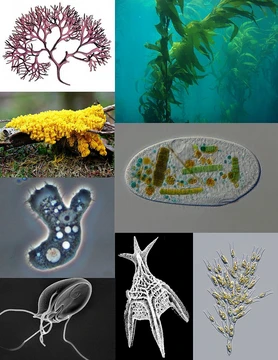
Golden algae
Golden algae are freshwater algae with siliceous cysts and two flagella.

The Chrysophyceae, commonly called golden algae, golden-brown algae, or chrysophytes, are a large group of algae found mostly in freshwater. They are distinguished by the presence of two specialized flagella in motile cells and the ability to form siliceous cysts (statospores) endogenously. Their classification has been subject to extensive revision, and they are now usually restricted to a core group of closely related forms, often treated as the order Chromulinales.
- field
- Phycology (algal biology)
- known_for
- Golden-brown pigmentation (fucoxanthin), siliceous cysts, and importance in freshwater food web dynamics
- habitat
- Mostly freshwater
- classification
- Class Chrysophyceae, placed by some in the polyphyletic Chromista; broader monophyletic group is Stramenopiles
Lore & Background
The Chrysophyceae were originally taken to include diatoms and multicellular brown algae, but have since been divided into several groups (e.g., Haptophyceae, Synurophyceae) based on pigmentation and cell structure. Some heterotrophic flagellates such as bicosoecids and choanoflagellates were sometimes seen as related, but the class is now usually restricted to a core group distinguished primarily by flagellar structure in motile cells. Membership may be revised further as more species are studied.
Reader's Guide
Golden algae are significant for studies of food web dynamics in oligotrophic freshwater ecosystems and for assessing environmental degradation from eutrophication and acid rain. They contain the pigment fucoxanthin, which once led to their being considered a specialized form of cyanobacteria, but fossil evidence shows they are not derived from cyanobacteria but from a non-photosynthetic ancestor. The most primitive stramenopiles are heterotrophic, and the ancestors of the Chrysophyceae likely obtained photosynthesis from an endosymbiotic relationship with fucoxanthin-containing cyanobacteria. Their siliceous cysts provide a relatively complete fossil record, aiding evolutionary studies. 1990, van den Hoek et al.
Did You Know?
- The Chrysophyceae should not be confused with the Chrysophyta, which is a more ambiguous taxon.
- An important characteristic is the presence of a siliceous cyst formed endogenously, called a statospore, stomatocyst, or statocyst.
- One species, Myxochrysis paradoxa, has a complex life cycle involving a multinucleate plasmodial stage similar to slime molds.
- The broader monophyletic group to which the Chrysophyceae belong includes various non-algae such as bicosoecids, opalines, oomycete fungi, and actinophryid heliozoa, and is referred to as the Stramenopiles.
Frequently Asked Questions
What is Golden algae?
Golden algae (Chrysophyceae) are a large group of freshwater algae instantly recognizable by their golden-brown hue, produced by the carotenoid fucoxanthin. They also stand out for their capacity to build tiny siliceous resting cysts called statospores from within the cell.
What are Golden algae's signature traits?
Motile members carry two specialized flagella, and the group can generate siliceous cysts endogenously—two features that distinguish them from most other algal lineages. Their golden-brown pigmentation ties them visually to the broader stramenopile clade.
Where do Golden algae live?
They are overwhelmingly freshwater organisms, most often encountered in lakes, ponds, and slow-moving streams rather than in the ocean. This freshwater preference is a defining part of their ecological identity.
How is Golden algae classified?
After years of taxonomic reshuffling, the name Chrysophyceae is now typically restricted to a core clade of closely related forms, often treated as the order Chromulinales. They belong to the monophyletic group Stramenopiles, and some broader schemes slot them into the polyphyletic Chromista.
Why is Golden algae important?
They are key primary producers in freshwater food webs, channeling energy into higher trophic levels and shaping the dynamics of entire aquatic ecosystems. This ecological role is a major reason phycologists continue to study and revise their classification.
More in Algae And Protists 1-24
Spotted an error? Know more?
This is a living reference — every entry is fact-audited, and reader corrections feed straight into our audit queue. Suggest an edit · See this site's audit record