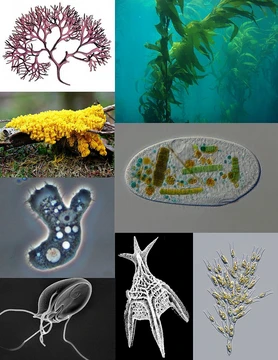
Euglenid
Single-celled flagellates with diverse nutrition and a flexible pellicle.

Euglenids, also known as euglenoids, are a diverse group of single-celled eukaryotic flagellates classified in the phylum Euglenozoa, class Euglenida or Euglenoidea. They are best known for their flagella, or whip-like tails, and are commonly found in fresh water rich in organic materials, with a few marine and endosymbiotic members. Their significance lies in their varied modes of nutrition—phagocytosis, osmotrophy, and photosynthesis—and their distinctive cell covering called a pellicle, which can be rigid or flexible and allows some species to move via an inching motion called metaboly.
- field
- Protistology
- known_for
- Diverse nutrition modes (phagotrophy, osmotrophy, phototrophy); pellicle structure; metaboly; secondary endosymbiosis with green algae
- classification
- Phylum Euglenozoa, class Euglenida/Euglenoidea, supergroup Discoba
- oldest_fossil
- Moyeria, from Middle Ordovician and Silurian rocks
Lore & Background
Euglenids split from other Euglenozoa more than a billion years ago. Their plastids in all extant photosynthetic species result from secondary endosymbiosis between a euglenid and a green alga. The pellicle, composed of proteinaceous strips under the cell membrane, is one of their most diverse morphological features; strips can slide past one another in many species, causing metaboly. Later systems by A.
Reader's Guide
Euglenids are significant as a highly diverse clade within Euglenozoa, illustrating evolutionary transitions between phagotrophy, osmotrophy, and phototrophy. Their pellicle structure provides insight into movement and nutrition modes. The monophyletic subgroup Euglenophyceae, which contains chloroplasts and produces paramylon, represents a key example of secondary endosymbiosis. The earliest fossil evidence, Moyeria, dates to the Middle Ordovician and Silurian, indicating ancient origins. Classification remains variable, with molecular phylogeny revising traditional groups based on nutrition and flagella. Euglenids reproduce only asexually via longitudinal binary fission, a trait that distinguishes them from animals. Their study informs understanding of eukaryotic evolution, endosymbiosis, and the diversity of microbial life in freshwater ecosystems.
Did You Know?
- Euglenids split from other Euglenozoa more than a billion years ago.
- The pellicle is composed of proteinaceous strips; only euglenids with more than 18 strips gain flexibility for metaboly.
- No evidence of sexual reproduction has been found in euglenids; they reproduce by longitudinal binary fission.
- The earliest fossil of euglenids, Moyeria, is found in Middle Ordovician and Silurian rocks.
Frequently Asked Questions
Who is Euglenid?
Euglenid refers to a large family of single-celled, flagellated eukaryotes placed in the phylum Euglenozoa and the class Euglenida. They are most easily recognized by their whip-like flagella and a distinctive outer cell covering called a pellicle that can be either stiff or flexible.
What are Euglenid's powers or special abilities?
Euglenids can feed in several ways at once—swallowing particles, absorbing dissolved nutrients, or producing their own food via photosynthesis. Some species also perform a unique inching locomotion called metaboly, in which their pellicle rhythmically contracts and extends to push them forward.
Where does Euglenid live?
The vast majority of euglenid species inhabit freshwater bodies that are rich in decaying organic matter, though a small number occur in marine environments or reside inside other organisms as endosymbionts.
How old is Euglenid and where did it come from?
The oldest confirmed euglenid fossil, Moyeria, has been pulled from Middle Ordovician and Silurian rock layers, pushing the group's verified history back hundreds of millions of years. Their lineage is also deeply tied to green algae through a secondary endosymbiosis event.
Why is Euglenid important to the field of protistology?
Euglenids sit at the center of protist research because they blend animal-like and plant-like feeding strategies in a single cell, making them a go-to model for probing the boundaries between protist nutritional modes. Their flexible pellicle and metaboly also serve as textbook examples of adaptable cell architecture in single-celled life.
More in Algae And Protists 1-24
Spotted an error? Know more?
This is a living reference — every entry is fact-audited, and reader corrections feed straight into our audit queue. Suggest an edit · See this site's audit record