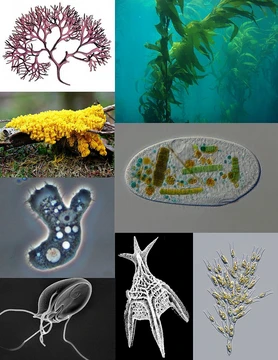
Diatom
Microalgae that produce much of Earth's oxygen and form silica shells.

Diatoms are a large group of microalgae found in oceans, waterways, and soils worldwide. They generate an estimated 20 to 50 percent of the oxygen produced on Earth each year and constitute nearly half of the organic material in the oceans, making them a significant component of global biomass and the carbon cycle.
- field
- Phycology
- known_for
- Silica cell walls (frustules), major oxygen producers, foundation of marine food webs
- size_range
- 2 to 2000 micrometers
- life_span
- About six days per cell
Lore & Background
Diatoms are unicellular organisms that occur as solitary cells or in colonies shaped as ribbons, fans, zigzags, or stars. They have two distinct forms: centric diatoms, which are radially symmetric, and pennate diatoms, which are bilaterally symmetric. Their cell walls, called frustules, are made of silica and produce structural coloration, leading to descriptions such as 'jewels of the sea' and 'living opals.' Movement is primarily passive via currents and turbulence, though male gametes of centric diatoms have flagella for active movement. Diatoms convert light energy to chemical energy through photosynthesis, but unusually for autotrophic organisms, they possess a urea cycle similar to animals. Some diatoms, such as those in the family Rhopalodiaceae, host nitrogen-fixing cyanobacterial endosymbionts. Diatoms are used to monitor past and present environmental conditions and water quality. Their accumulated shells form diatomaceous earth, a soft, silica-rich sedimentary rock used for water filtration, as a mild abrasive, in cat litter, and as a dynamite stabilizer. The Amazon basin receives an annual fertilization of 27 million tons of diatom shell dust transported by transatlantic winds from the African Sahara, much of it from the Bodélé Depression.
Reader's Guide
Diatoms are among the most ecologically significant organisms on Earth. They generate 20 to 50 percent of the planet's oxygen and take in over 6.7 billion tonnes of silicon annually from waters. Their annual blooms fuel marine food webs and drive carbon export to the deep ocean. The study of diatoms, a branch of phycology, provides insights into past climates and water quality through fossil frustules preserved in sediments. Diatomaceous earth, derived from ancient diatom deposits, has practical applications in filtration, abrasives, and industrial stabilizers. The discovery of shell-less diatoms within dinoflagellates (dinotoms) highlights ongoing evolutionary processes. Their unique silica frustules and complex life cycles, including size reduction through division and restoration via auxospore formation, make them a model for studying biomineralization and evolutionary biology.
Did You Know?
- Diatoms generate an estimated 20 to 50 percent of the oxygen produced on Earth each year.
- The Amazon basin receives 27 million tons of diatom shell dust annually from the African Sahara.
- The oldest fossil evidence of diatoms is a specimen of Hemiaulus in Late Jurassic amber from Thailand.
- Diatoms possess a urea cycle, a feature they share with animals, though used for different metabolic ends.
Frequently Asked Questions
Who is Diatom?
Diatom is a microalga in the phylum Bacillariophyta, found in oceans, freshwater systems, and soils across the globe. In the Algae And Protists series they hold entry 1-24 and are instantly recognizable by their glass-like cell walls.
What are Diatom's powers/role?
Diatoms generate an estimated 20 to 50 percent of all oxygen released into Earth's atmosphere each year. They also account for nearly half of all organic material in the oceans, serving as the foundational producers that anchor marine food webs.
How does Diatom's story end?
Each individual diatom cell lives for roughly six days before it divides and hands its lineage to the next generation. There is no single finale for the group, because new cells keep forming endlessly as long as conditions allow.
Why is Diatom important?
Diatoms are a linchpin of global biomass and the carbon cycle, cycling enormous quantities of carbon through the water column. Losing them would devastate marine ecosystems and cut a massive share of the planet's annual oxygen output.
What makes Diatom's design unique?
Diatoms build their cell walls, called frustules, out of silica, producing intricate geometric patterns visible under a microscope. Their size spans a wide range from 2 to 2000 micrometers, and these ornate glass shells have made them a beloved subject in phycology.
More in Algae And Protists 1-24
Spotted an error? Know more?
This is a living reference — every entry is fact-audited, and reader corrections feed straight into our audit queue. Suggest an edit · See this site's audit record