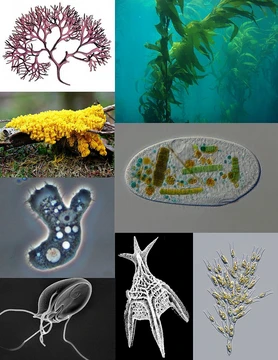
Cryptomonad
Algae and flagellates with ejectosomes and a nucleomorph.

Cryptomonads, also known as cryptophytes, are a group of algae and colorless flagellates, most of which possess plastids. They are traditionally considered a division of algae under the name Cryptophyta. Common in freshwater, they also occur in marine and brackish habitats. Each cell is around 10–50 μm in size, flattened, with an anterior groove or pocket and two slightly unequal flagella. Some exhibit mixotrophy. They are typically divided into two groups: the heterotrophic Goniomonadea and the phototrophic Cryptophyceae, though Goniomonadea is often considered a subgroup within Cryptophyceae rather than a separate class. Both groups share a periplast, ejectisomes with secondary scroll, and flattened (discoidal) mitochondrial cristae.
- classification
- Division Cryptophyta, typically with Goniomonadea as a subgroup within Cryptophyceae
Lore & Background
Botanists later treated them as a separate algae group, class Cryptophyceae or division Cryptophyta, while zoologists treated them as the flagellate protozoa order Cryptomonadina. In some classifications, they were considered close relatives of dinoflagellates due to seemingly similar pigmentation, grouped as Pyrrhophyta. However, cryptomonad chloroplasts are closely related to those of heterokonts and haptophytes, leading Cavalier-Smith to unite them as Chromista, though the case that the organisms themselves are closely related was counter-indicated by major differences in cell organization, suggesting the three lineages acquired plastids independently and that chromists are polyphyletic.
Reader's Guide
Cryptomonads are significant for understanding plastid evolution, as their chloroplasts are surrounded by four membranes and contain a reduced nucleus called a nucleomorph, indicating derivation from a eukaryotic symbiont—shown by genetic studies to have been a red alga. However, their plastids are very different from red algal plastids: phycobiliproteins are present only in the thylakoid lumen and only as phycoerythrin or phycocyanin. The perspective that cryptomonads are primitively heterotrophic and secondarily acquired chloroplasts is supported by molecular evidence. The sister group to cryptomonads is likely the kathablepharids, a group of flagellates that also have ejectisomes. Parfrey et al. and Burki et al. placed Cryptophyceae as a sister clade to green algae or green algae plus glaucophytes.
Did You Know?
- Cryptomonads have ejectosomes consisting of two connected spiral ribbons held under tension, which discharge when the cell is irritated, propelling it in a zig-zag course.
- Except for the class Goniomonadea and Cryptomonas paramecium, cryptomonads have one or two chloroplasts containing chlorophylls a and c, together with phycobiliproteins.
- The nucleomorph between the middle two of the four chloroplast membranes indicates the plastid was derived from a eukaryotic symbiont, shown to have been a red alga.
- Some Cryptomonas species can form palmelloid stages or immotile microbial cysts with rigid cell walls to survive unfavorable conditions.
Frequently Asked Questions
What is a Cryptomonad?
Cryptomonads, or cryptophytes, are a division of algae and colorless flagellates traditionally classified under the name Cryptophyta. Most members carry plastids, and each cell is a small, flattened organism roughly 10 to 50 micrometers in size.
What are Cryptomonad's key features or 'powers'?
Each cell bears an anterior groove or pocket, two slightly unequal flagella, and ejectosomes. Many also retain a nucleomorph—a remnant nucleus from a secondary endosymbiotic event—and some species practice mixotrophy by blending photosynthesis with heterotrophic feeding.
Where does Cryptomonad live and what is its ecological role?
They are most abundant in freshwater but also occur in marine and brackish habitats. Ecologically they span multiple trophic levels: the phototrophic Cryptophyceae act as primary producers, while the heterotrophic Goniomonadea function as consumers.
How is Cryptomonad classified?
The group is traditionally treated as the division Cryptophyta, split into the phototrophic Cryptophyceae and the heterotrophic Goniomonadea. In many modern treatments, however, Goniomonadea is nested as a subgroup within Cryptophyceae rather than kept as a separate class.
Why is Cryptomonad important in protist biology?
Their nucleomorph makes them one of the clearest living examples of a third level of endosymbiosis, offering a direct window into how complex plastids evolved. They also serve as key model organisms for studying the transition between photosynthetic and heterotrophic lifestyles in single-celled eukaryotes.
More in Algae And Protists 1-24
Spotted an error? Know more?
This is a living reference — every entry is fact-audited, and reader corrections feed straight into our audit queue. Suggest an edit · See this site's audit record