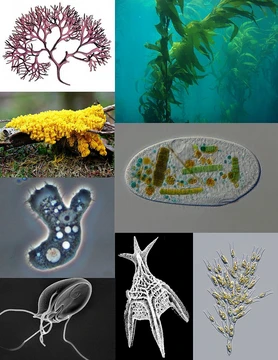
Chromalveolata
A proposed eukaryote supergroup later found not to be monophyletic.

The group included diverse organisms such as diatoms, brown algae, dinoflagellates, and water molds, many of which were historically considered plants or fungi.
- field
- Biological classification (eukaryote supergroup)
- nationality
- Proposed by Thomas Cavalier-Smith
- known_for
- Proposed as one of six major eukaryote groups; later split into SAR group and Hacrobia
Lore & Background
Chromalveolata was proposed to represent organisms descended from a single secondary endosymbiosis involving a red alga and a bikont. The plastids in these organisms contain chlorophyll c. Historically, many chromalveolates were considered plants due to their cell walls, photosynthetic ability, and morphological resemblance to land plants. Under the five-kingdom system, most were placed in Protista, while water molds and slime nets went to Fungi, and brown algae stayed in the plant kingdom. Cavalier-Smith later grouped them as Chromalveolata, believing them monophyletic, but this was not the case. The Chromalveolata were divided into four major subgroups: Cryptophyta, Haptophyta, Stramenopiles (or Heterokontophyta), and Alveolata. Other groups possibly included were Centrohelida, Kathablepharidae, and Telonemia. Most chromalveolates are autotrophic, using chlorophylls a and c, and many use accessory pigments. They share similar glyceraldehyde 3-phosphate dehydrogenase proteins. The four original subgroups fall into at least two categories: one comprises Stramenopiles and Alveolata, to which Rhizaria are usually added to form the SAR group; the other comprises Cryptophyta and Haptophyta. Various names have been used for combinations: Halvaria (Stramenopiles + Alveolata), SAR group (Halvaria + Rhizaria), and Hacrobia (Haptophyta + Cryptophyta).
Reader's Guide
Chromalveolata's significance lies in its role as a major classification hypothesis that shaped eukaryote taxonomy for nearly a decade. Although the group was ultimately rejected as non-monophyletic, its study revealed deep evolutionary relationships among diverse organisms. The proposal that all chromalveolates descended from a single secondary endosymbiosis with a red alga spurred research into plastid evolution. The eventual splitting of Chromalveolata into the SAR group (Stramenopiles, Alveolata, Rhizaria) and Hacrobia (Haptophyta, Cryptophyta) refined our understanding of eukaryotic phylogeny. Ecologically, many former chromalveolates remain crucial: diatoms are major photosynthetic producers, brown algae create marine habitats, and dinoflagellates cause harmful red tides. Apicomplexans include serious animal parasites like Plasmodium, and water molds cause plant diseases such as the Irish potato blight. The group's legacy is a cautionary tale about the limits of morphological and biochemical data in resolving deep evolutionary history, and a testament to the power of molecular phylogenetics.
Did You Know?
- Chromalveolata was proposed to represent organisms descended from a single secondary endosymbiosis involving a red alga and a bikont.
- The four major subgroups were Cryptophyta, Haptophyta, Stramenopiles, and Alveolata.
- Diatoms, a former chromalveolate group, produce much of the oxygen we breathe and take in much of the carbon dioxide from the atmosphere.
- The water mold Phytophthora infestans, a former chromalveolate, caused the Irish potato blight that led to the Great Irish Famine.
Frequently Asked Questions
Who is Chromalveolata?
Chromalveolata is a proposed eukaryote supergroup introduced by Thomas Cavalier-Smith as one of six major lineages in his framework for classifying eukaryotic life. It was meant to unite a broad collection of organisms that share certain chromatin-related structural features.
What are Chromalveolata's powers and role?
Its roster spans diatoms, brown algae, dinoflagellates, and water molds—groups that were long misfiled as plants or fungi. In the narrative of eukaryotic taxonomy it served as a catch-all bucket for organisms bearing complex, multi-membrane plastids.
How does Chromalveolata's story end?
Subsequent phylogenetic analyses showed the group was not monophyletic, meaning its members do not all trace back to a single common ancestor. It was subsequently dismantled, with most former members reassigned to the SAR clade and the remainder to Hacrobia.
Why is Chromalveolata important to the canon?
It shaped how biologists organized the tree of life for well over a decade and highlighted how easily superficial similarities can mislead classification. Its eventual dissolution became a textbook example of why monophyly is essential in systematics.
Who created Chromalveolata, and when did the concept appear?
Thomas Cavalier-Smith proposed the supergroup in the late 1990s as part of his six-kingdom framework for eukaryotes. Though the name has since fallen out of favor, it remains a recognizable landmark in the history of protist taxonomy.
More in Algae And Protists 1-24
Spotted an error? Know more?
This is a living reference — every entry is fact-audited, and reader corrections feed straight into our audit queue. Suggest an edit · See this site's audit record