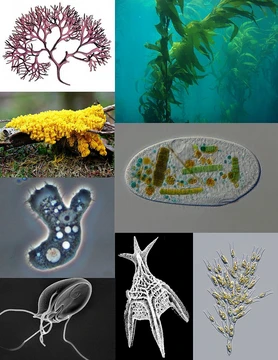
Ciliate
Ciliates are protists with cilia and two distinct nuclei.

Ciliates are a group of alveolates characterized by the presence of hair-like organelles called cilia, which are identical in structure to eukaryotic flagella but are generally shorter and more numerous, with a different undulating pattern. They are an important group of protists, common almost anywhere there is water, including anoxic habitats, and include some of the most morphologically complex protozoans.
- field
- Protistology
- known_for
- Possessing two different sorts of nuclei (micronucleus and macronucleus) and using cilia for locomotion and feeding
- size_range
- From 10 μm to 4 mm
Lore & Background
Ciliates reproduce asexually by various kinds of fission, during which the micronucleus undergoes mitosis and the macronucleus elongates and undergoes amitosis, except among Karyorelictean ciliates. Conjugation is a sexual phenomenon that results in genetic recombination and nuclear reorganization, involving the exchange of haploid micronuclei between compatible mating types. In most ciliate groups, cells separate after conjugation and both form new macronuclei from their micronuclei.
Reader's Guide
Ciliates are significant as a morphologically diverse and widespread group of protists, inhabiting nearly all aquatic environments. Their unique nuclear dualism—with a germline micronucleus and a somatic macronucleus—provides a model for studying genome rearrangement and epigenetic regulation. The presence of alveoli, the structure of cilia, and the form of mitosis indicate a close relationship with Apicomplexa and dinoflagellates, together forming the alveolates. Ciliates play key ecological roles as heterotrophs, mixotrophs, and parasites, with only one species, Balantidium coli, known to cause disease in humans. Their complex infraciliature and varied feeding techniques, including the observation of Halteria feeding on chloroviruses, highlight their evolutionary adaptations.
Did You Know?
- Ciliates have two different sorts of nuclei: a tiny, diploid micronucleus and a large, ampliploid macronucleus.
- The ciliate Halteria has been observed to feed on chloroviruses.
- While Balantidium coli is the most well-known, other ciliates like Tetrahymena and Colpoda have been reported in opportunistic infections in humans.
- Ciliate conjugation is a sexual phenomenon that results in genetic recombination and nuclear reorganization.
Frequently Asked Questions
What is a ciliate?
A ciliate is a type of alveolate protist that moves and feeds using numerous short, hair-like structures called cilia. These cilia are structurally the same as eukaryotic flagella but are shorter, more abundant, and beat in a distinct undulating pattern.
What makes ciliates unique among protists?
Ciliates are famous for harboring two entirely different kinds of nuclei—a micronucleus and a macronucleus—within a single cell. They also rank among the most morphologically complex protozoans known.
How big do ciliates get?
Individual ciliate cells range from roughly 10 micrometers up to about 4 millimeters in length, spanning a wide size spectrum within the group.
Where can you find ciliates in nature?
Ciliates are nearly ubiquitous in aquatic environments and can even thrive in oxygen-poor (anoxic) habitats. In short, wherever there is water, you are likely to encounter them.
Why are ciliates considered important in protistology?
They serve as a key model group for studying eukaryotic cell complexity, nuclear dualism, and ciliary motility. Their widespread distribution and morphological diversity make them a cornerstone of the field.
More in Algae And Protists 1-24
Spotted an error? Know more?
This is a living reference — every entry is fact-audited, and reader corrections feed straight into our audit queue. Suggest an edit · See this site's audit record