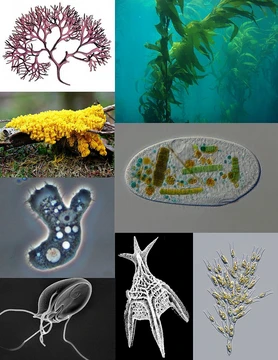
Dinoflagellate
Single-celled protists causing red tides and bioluminescence.

Dinoflagellates are a monophyletic group of single-celled eukaryotes constituting the phylum Dinoflagellata, usually considered protists. They are mostly marine plankton but also common in freshwater habitats, with populations varying by sea surface temperature, salinity, and depth. Many are photosynthetic, though a large fraction are mixotrophic, combining photosynthesis with ingestion of prey. Some species are endosymbionts of marine animals and play an important part in coral reef biology, while others are unpigmented predators or parasitic forms. A rapid accumulation of certain dinoflagellates can cause red tide, a harmful algal bloom that can lead to shellfish poisoning in humans. Some dinoflagellates also exhibit bioluminescence, primarily emitting blue-green light.
- field
- Protistology, Marine Biology
- known_for
- Red tide harmful algal blooms, bioluminescence, mixotrophy, dinokaryon nucleus
- etymology
- Greek 'dinos' (whirling) + Latin 'flagellum' (whip)
Lore & Background
The term 'dinoflagellate' combines Greek 'dinos' (whirling) and Latin 'flagellum' (whip), referring to their distinctive swimming motion and flagella. In the 1830s, Christian Gottfried Ehrenberg proposed several genera still used today, including Peridinium, Prorocentrum, and Dinophysis. Botanists treated them as a division of algae named Pyrrophyta or Dinophyta.
Reader's Guide
Dinoflagellates are significant as one of the largest groups of marine eukaryotes, though substantially smaller than diatoms. They play a critical role in marine ecosystems, particularly as endosymbionts of coral reefs. Their ability to produce harmful algal blooms (red tides) has major economic and health impacts, causing shellfish poisoning. Their bioluminescence is a notable natural phenomenon. The group's evolutionary history is difficult to reconstruct due to their known ability to transform from noncyst to cyst-forming strategies. Their unique dinokaryon nucleus, with reduced histones and viral-origin DVNPs, and their complex thecal plate arrangements (tabulation) are key morphological features. Dinoflagellates are alveolates, closely related to Apicomplexa and ciliates. Their chloroplasts derive from multiple endosymbiotic events, including secondary endosymbiosis of red algae, green algae, and tertiary endosymbiosis of diatoms.
Did You Know?
- Dinoflagellates have a peculiar nucleus called a dinokaryon, where chromosomes are attached to the nuclear membrane and contain viral-origin DVNPs instead of histones.
- The dinoflagellate Erythropsidinium has the smallest known eye.
- Some athecate dinoflagellates have an internal skeleton of two star-like siliceous elements that can be found as microfossils.
Frequently Asked Questions
Who is Dinoflagellate?
Dinoflagellate is a single-celled eukaryotic protist in the phylum Dinoflagellata, most often encountered as marine plankton but also found in freshwater. The name blends the Greek word for 'whirling' with the Latin word for 'whip,' a nod to the two flagella that spin the cell through water.
What are Dinoflagellate's powers or abilities?
Many dinoflagellates glow through bioluminescence, and a large share practice mixotrophy by pairing photosynthesis with actively ingesting prey. Some live as endosymbionts inside coral polyps, while others exist as unpigmented predators or parasitic forms.
How does Dinoflagellate's story end?
When certain species multiply explosively, they trigger harmful algal blooms commonly called red tides, which can strip dissolved oxygen from the water and release toxins that kill fish and invertebrates. The bloom eventually collapses once local nutrients are exhausted, though the ecological fallout can linger well after the cells die off.
Why is Dinoflagellate important in the ecosystem?
As photosynthetic plankton, dinoflagellates contribute meaningfully to marine primary production and oxygen output. They also underpin coral reef biology by serving as endosymbionts, making them indispensable partners in one of the ocean's most biodiverse habitats.
What makes Dinoflagellate's cell structure unique?
Dinoflagellates house a distinctive nucleus called a dinokaryon, which sets them apart from most other eukaryotes. Their two flagella—one running transversely and one seated in a groove—produce a characteristic whirling motility that gave the group its name.
More in Algae And Protists 1-24
Spotted an error? Know more?
This is a living reference — every entry is fact-audited, and reader corrections feed straight into our audit queue. Suggest an edit · See this site's audit record