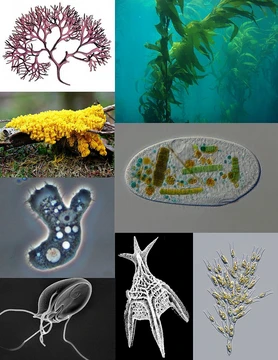
Alveolate
A diverse protist clade with cortical alveoli and tubular mitochondrial cristae.

The alveolates are a major clade of protists within the Eukaryota, grouped with the Stramenopiles and Rhizaria into the SAR supergroup. They are characterized by cortical alveoli (flattened sacs) under the cell membrane, mitochondria with tubular cristae, and often pore-like intrusions through the cell surface.
- field
- Protistology
- known_for
- Possession of cortical alveoli, tubular mitochondrial cristae, and inclusion of ciliates, dinoflagellates, and apicomplexans
- classification
- Superphylum within SAR supergroup
- major_groups
- Ciliophora, Dinoflagellata, Perkinsea, Colpodellida, Apicomplexa, Squirmida
Lore & Background
The relationship among apicomplexans, dinoflagellates, and ciliates was suggested during the 1980s and confirmed in the early 1990s by ribosomal RNA sequence comparisons, notably by Gajadhar et al. Many biologists prefer the colloquial name 'alveolate'. The alveolates include around six major groups: Ciliophora, Dinoflagellata s.l., Perkinsea, Colpodellida, Apicomplexa, and Squirmida. The Acavomonidia and Colponemidia were formerly grouped as colponemids but are now recognized as non-sister groups. The Apicomplexa and dinoflagellates may be more closely related to each other than to ciliates, sharing plastids and a bundle of microtubules at the cell apex.
Reader's Guide
The alveolates are significant as a major clade within the eukaryotic tree of life, illustrating key evolutionary transitions such as the acquisition and loss of plastids. The development of plastids among alveolates is intriguing: Cavalier-Smith proposed a common photosynthetic ancestor for alveolates and Chromista (the chromalveolate hypothesis), and evidence now suggests that alveolates, dinoflagellates, Colpodellida, and heterokont algae acquired plastids from a red alga with a common origin. The term Myzozoa is used informally for the common ancestor of alveolates that are neither ciliates nor colponemids, reflecting the importance of predation upon algae as a driver of evolution and endosymbiosis. Ciliates, as model alveolates, have been studied genetically in great depth and illustrate the dynamic balance between predation and autotrophy. The group's diversity—from free-living flagellates to obligate parasites like apicomplexans—makes it a key subject for understanding protist biology, endosymbiosis, and the evolution of complex cellular structures.
Did You Know?
- Almost all sequenced mitochondrial genomes of ciliates and apicomplexa are linear, with exceptions including the circular genomes of Acavomonas and Babesia microti.
- The alveolates are grouped with Stramenopiles and Rhizaria into the SAR supergroup based on tubulocristate mitochondria.
Frequently Asked Questions
Who is Alveolate?
Alveolate is a superphylum-level clade of protists that, together with Stramenopiles and Rhizaria, forms the three main branches of the SAR supergroup. It is one of the largest and most diverse eukaryotic lineages.
What are Alveolate's defining traits?
Members carry flattened, membrane-bound sacs called cortical alveoli pressed just beneath the cell surface, and their mitochondria contain distinctive tube-shaped cristae. Many also display pore-like invaginations that pierce through the cell membrane.
What major groups does Alveolate include?
The clade encompasses Ciliophora, Dinoflagellata, Perkinsea, Colpodellida, Apicomplexa, and Squirmida. This range stretches from free-swimming ciliates and photosynthetic dinoflagellates to obligate parasites within the apicomplexan lineage.
Why is Alveolate important in protistology?
It unites an enormous span of ecological strategies—filter feeders, predators, symbionts, and disease-causing parasites—under a single evolutionary framework. Its position within SAR also helps anchor the broader tree of eukaryotic diversity.
Where does Alveolate sit in the classification?
It is ranked as a superphylum nested inside the SAR supergroup of Eukaryota, making it a sister lineage to both Stramenopiles and Rhizaria rather than a standalone kingdom-level group.
More in Algae And Protists 1-24
Spotted an error? Know more?
This is a living reference — every entry is fact-audited, and reader corrections feed straight into our audit queue. Suggest an edit · See this site's audit record