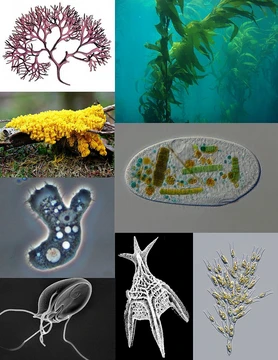
Kelp
Large brown algae forming dense underwater forests.

Kelps are large brown algae or seaweeds that make up the order Laminariales, comprising about 30 genera. Despite their plant-like appearance and use of photosynthesis in chloroplasts, kelps are not plants but stramenopiles. They grow from stalks in dense, forest-like areas under shallow temperate and Arctic oceans, requiring nutrient-rich water with temperatures between 6 and 14 °C. Kelps are known for their fast growth, with genera such as Macrocystis and Nereocystis capable of growing up to half a metre per day and reaching lengths of 30 to 80 metres. Through the 19th century, the word 'kelp' was closely associated with seaweeds burned to obtain soda ash, and also referred to the processed ashes themselves.
- classification
- Stramenopile (brown algae, order Laminariales)
- number_of_genera
- About 30
- earliest_known_occurrence
- At least 32 million years ago in the northeastern Pacific Ocean
- growth_rate
- Up to half a metre (about 20 inches) per day
- temperature_range
- 6 to 14 °C (43 to 57 °F)
- historical_use
- Burned to produce soda ash (sodium carbonate)
Lore & Background
Kelps have a thallus consisting of flat or leaf-like lamina (blades) originating from elongated stipes, anchored by a root-like holdfast. Gas-filled bladders called pneumatocysts form at the base of blades in American species like Nereocystis lueteana, holding the blades near the surface for light. The stipes are covered with a slimy mucilage layer rather than a waxy cuticle. Growth occurs at the base of the meristem, where blades and stipe meet, and can be limited by grazing, such as by sea urchins that can create urchin barrens. The life cycle involves a diploid sporophyte and haploid gametophyte stage, beginning when spores germinate into male or female gametophytes, leading to sexual reproduction and a new sporophyte.
Reader's Guide
Kelps are significant as ecosystem engineers, forming kelp forests that are among the most diverse and dynamic ecosystems on Earth. Their fast growth and ability to form dense underwater canopies provide habitat and food for numerous marine species. The evolutionary history of kelp illustrates convergent evolution with terrestrial plants, as well as within the group itself, leading to niche partitioning along wave disturbance gradients. Their adaptations, such as pneumatocysts for buoyancy and raft formation, have enabled successful dispersal via ocean currents, with some species like Macrocystis pyrifera showing recent colonization of subantarctic regions. The study of kelp structure and plasticity has informed understanding of how organisms adapt to turbulent ocean environments. Historically, kelp was economically important in the 19th century for producing soda ash. The ongoing research into kelp transport anatomy and functional traits continues to reveal the complexity of brown algal evolution and their role in marine ecosystems.
Did You Know?
- Kelp is not a plant but a stramenopile, despite using photosynthesis in chloroplasts.
- Some kelp species can grow as fast as half a metre per day, reaching up to 80 metres in length.
- The word 'kelp' was historically used for seaweeds burned to obtain soda ash, as well as for the ashes themselves.
- Kelp have evolved gas-filled bladders called pneumatocysts to hold blades near the surface for light.
Frequently Asked Questions
What is Kelp?
Kelp refers to large brown algae grouped under the order Laminariales, which contains roughly 30 genera. Although they photosynthesize in chloroplasts and look plant-like, kelps are actually stramenopiles—a lineage of protists rather than true plants.
How fast can Kelp grow?
Genera such as Macrocystis and Nereocystis can add up to half a metre of new frond tissue in a single day. Over a full season, individual kelps can stretch to 30 or even 80 metres in length.
Where does Kelp live?
Kelps anchor to the seafloor and form dense, forest-like canopies in shallow temperate and Arctic waters. They depend on nutrient-rich currents and water temperatures between 6 and 14 °C to thrive.
How long has Kelp existed?
The fossil record places the earliest known kelps in the northeastern Pacific Ocean at least 32 million years ago. That makes them one of the older lineages within the broader stramenopile group.
Why is Kelp important to humans?
Throughout the 19th century, people burned dried kelp to extract soda ash (sodium carbonate), a key ingredient in glassmaking and soap production. Ecologically, their underwater forests also shelter a huge variety of marine organisms.
More in Algae And Protists 1-24
Spotted an error? Know more?
This is a living reference — every entry is fact-audited, and reader corrections feed straight into our audit queue. Suggest an edit · See this site's audit record