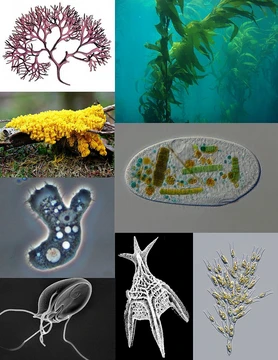
Amoeba
Unicellular organisms that change shape using pseudopods.

An amoeba (or ameba) is a type of cell or unicellular organism capable of altering its shape by extending and retracting pseudopods. Amoebae are not a single taxonomic group but appear in every major lineage of eukaryotic organisms, including protozoa, fungi, algae, and animals. They are best known for their amoeboid movement and are often studied in classrooms and laboratories.
- field
- Biology (Protistology)
- known_for
- Amoeboid movement via pseudopods; includes pathogens such as Entamoeba histolytica and Naegleria fowleri
Lore & Background
G. Ehrenberg. Amoebae lack cell walls and move by extending pseudopods—bulges of cytoplasm driven by actin microfilaments. Pseudopod types vary: lobose in Amoebozoa, filose in Cercozoa, reticulose in Foraminifera, and axopodia in Radiolaria and Heliozoa. Freshwater amoebae use a contractile vacuole to expel excess water, while marine forms typically lack one. They feed by phagocytosis or pinocytosis, and their size ranges from 2.3 micrometres (Massisteria voersi) to 20 cm (xenophyophore shells). Some amoebae are pathogenic: Entamoeba histolytica causes amoebic dysentery; Naegleria fowleri is a freshwater species fatal if introduced through the nose; Acanthamoeba causes keratitis and encephalitis; Balamuthia mandrillaris causes granulomatous amoebic meningoencephalitis. Amoebae can also host bacterial pathogens such as Legionella.
Reader's Guide
Amoebae are significant as model organisms for studying cell movement, phagocytosis, and evolution. The best-known species—Chaos carolinense and Amoeba proteus—are widely used in education and research. Their ability to alter shape and engulf prey illustrates fundamental cellular processes. Molecular evidence suggests that several amoebozoan lineages, including Acanthamoeba, Entamoeba, and Dictyostelium discoideum, possess meiotic genes and may undergo sexual reproduction, indicating that meiosis was present early in eukaryotic evolution. Amoebae also play ecological roles as predators, detritivores, and hosts for pathogenic microbes. Their classification has shifted from the polyphyletic Sarcodina to a distribution across multiple eukaryotic supergroups, reflecting modern phylogenetic understanding. The study of amoebae continues to inform microbiology, evolutionary biology, and medicine.
Did You Know?
- Amoebae are found in every major lineage of eukaryotic organisms, including fungi, algae, and animals.
- The marine amoeboid Massisteria voersi is only 2.3 to 3 micrometres in diameter, similar to many bacteria.
- The 'brain-eating amoeba' Naegleria fowleri can be fatal if introduced through the nose.
- Some amoebae, such as Dictyostelium discoideum, are multicellular 'social amoebae' or slime moulds.
Frequently Asked Questions
What is Amoeba in Algae And Protists 1-24?
Amoeba refers to a group of unicellular eukaryotic organisms defined by their ability to reshape their body by extending and retracting pseudopods. They are not one single taxonomic clade but appear across multiple major eukaryotic lineages, from protozoa to fungi and even certain animal cell types.
What is Amoeba's signature ability?
Its defining trait is amoeboid locomotion, where the cell pushes out temporary lobes of cytoplasm called pseudopods to crawl, engulf food, or sense its surroundings. This shape-shifting movement is what makes amoebae one of the most instantly recognizable protists in any biology classroom.
Is Amoeba a single species or a broader category?
It is a broader morphological category rather than one species; the term describes a body plan shared by organisms spanning protozoa, fungi, algae, and some animal cell types. No single taxonomic rank unites all amoeboid cells, so the name functions more as a descriptive label than a formal classification.
Why is Amoeba important to study?
Beyond being a staple teaching model for cell biology, several amoeboid protists are serious human pathogens, including Entamoeba histolytica (causing amoebic dysentery) and Naegleria fowleri (causing fatal brain infections). Understanding their movement and feeding mechanics also sheds light on how eukaryotic cells interact with their environment.
Where do you typically encounter Amoeba in the wild or in the lab?
In nature, amoeboid cells thrive in freshwater ponds, soil, and marine sediments, where they feed on bacteria and organic debris. In the lab, species like Amoeba proteus remain a go-to organism for demonstrating phagocytosis, cytoskeletal dynamics, and basic eukaryotic cell behavior.
More in Algae And Protists 1-24
Spotted an error? Know more?
This is a living reference — every entry is fact-audited, and reader corrections feed straight into our audit queue. Suggest an edit · See this site's audit record