Frequently Asked Questions
The most-asked questions about algae and protists.
What exactly are algae and protists?
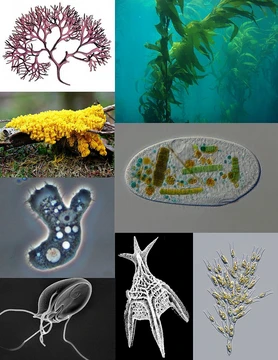
They are a sprawling collection of eukaryotic organisms—mostly single-celled or simply multicellular—that don't fit into the plant, animal, or fungal kingdoms. The photosynthetic members (algae) and the non-photosynthetic ones (amoebas, ciliates, slime molds, etc.) together make up one of the most diverse and ecologically critical groups of life on Earth.
Who are the most iconic 'characters' to know first?
Diatoms (glass-shelled microalgae), dinoflagellates (the red-tide producers), foraminifera (shell-building amoebas), and the parasitic apicomplexans (like the malaria parasite) are the lineages that show up most often in both research and public discussion.
Where should a newcomer begin exploring this group?
Start by separating the photosynthetic algae (green, red, and brown lineages) from the non-photosynthetic protists, then work outward from unicellular forms to the multicellular seaweeds. A basic grasp of eukaryotic cell biology—especially endosymbiosis—makes almost everything else click into place.
How large is the 'universe' we're talking about?
Conservative estimates place described protist species in the tens of thousands, but many researchers suspect the true count exceeds a million. The vast majority of marine and soil protists have never been formally named, so the group is still largely uncharted.
What is the single most pivotal 'origin story' in their history?
The endosymbiotic event in which an ancestral eukaryotic cell permanently incorporated a photosynthetic bacterium gave rise to the first true algae and, by extension, to every plant chloroplast on the planet. Without that one engulfing, there would be no forests, no grasses, and no oxygen-rich atmosphere.
What's one key ecological fact every fan should know?
Marine phytoplankton—overwhelmingly algae and protists—generate roughly half of the oxygen in Earth's atmosphere and anchor virtually every aquatic food web. A single liter of coastal seawater can contain millions of these microscopic organisms working in concert.
Which members are considered the 'villains' of the group?
Certain dinoflagellates produce potent neurotoxins during harmful algal blooms that devastate shellfish fisheries and kill marine wildlife. On the disease side, parasitic protists such as Plasmodium (malaria) and Trypanosoma (Chagas and sleeping sickness) collectively claim over a million human lives each year.
What's the most surprising or 'hidden depth' fact about them?
Some protists have undergone multiple nested rounds of endosymbiosis, meaning they harbor cells inside cells inside cells, a layered complexity that still puzzles systematists. Organisms in the class Paulinellia, for example, contain a secondary-algal endosymbiont that itself carries a tertiary one.
How do algae and protists relate to 'the main cast'—plants, animals, and fungi?
Protists are essentially the eukaryotic 'everything else,' sitting as the evolutionary bridge from which the plant and animal lineages later diverged. In a sense, every plant cell carries a protist ancestor in its chloroplast, making the group more foundational to the tree of life than any single 'kingdom.'
Where can fans go deeper once the basics are covered?
The AlgaeBase database, the Tree of Life web project, and Lynn Margulis's work on serial endosymbiosis are standard starting points for serious study. For a narrative overview, textbooks on protist biology by authors such as Cavalier-Smith or Fenchel tend to be the most accessible full-length treatments.